.png)
Tesco, the UK’s largest retailer, has announced the launch of a beta trial for a new AI assistant integrated directly into the existing Tesco app. The initiative, initially rolling out to the company’s 280,000 colleagues, represents a significant milestone in the retailer's long-term digital transformation. By utilising a "natural, two-way dialogue," the assistant is designed to transition the shopping experience from a manual search-and-select model to a conversational, personalised service.
The move marks a definitive step into the "predictive retail" space, where AI is used not just to facilitate transactions, but to manage household meal cycles and reduce food waste at scale.
Conversational Meal Planning
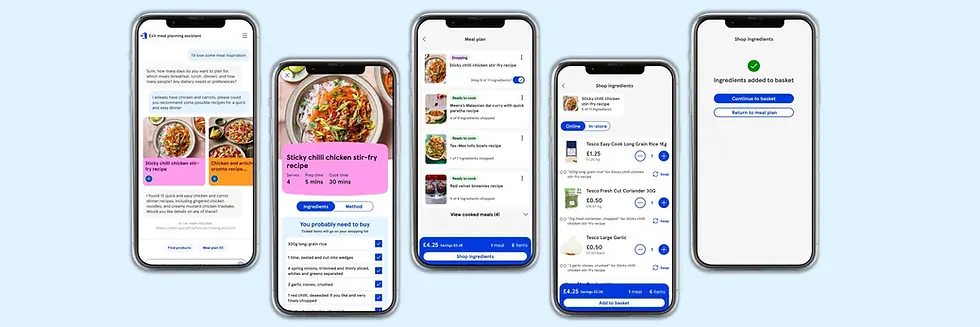
The AI assistant’s primary value proposition centres on "meal planning as a service." Unlike standard search filters, the assistant offers:
Personalised Recipe Generation: Providing recipe ideas that account for specific dietary preferences and historical shopping data.
Waste Reduction Optimisation: Helping customers use up leftover ingredients in their cupboards or refrigerators, a key driver for the brand’s sustainability goals.
Automated Basket Building: Once a recipe is selected, the assistant automatically identifies and adds suitable products to the user's digital basket based on their previous brand preferences and price sensitivities.
Ken Murphy, Tesco CEO, characterised the assistant as a tool to "transform the way people shop," emphasising that the technology’s ultimate goal is to save customers both time and money.
Tomoro AI and Mistral
The development of the assistant is the result of a sophisticated technical ecosystem. Tesco has collaborated with several high-profile AI firms to build a resilient and intelligent interface:
Tomoro AI: A UK-based consultancy founded in 2023 in alliance with OpenAI. Tomoro has been working under strict secrecy protocols with Tesco’s in-house data science and engineering teams since autumn 2025.
Mistral AI: Tesco recently signed a three-year strategic partnership with this European AI start-up to further develop specialised AI capabilities across its operations.
OpenAI Alliance: Through Tomorrow, the assistant leverages the underlying architecture of modern Large Language Models (LLMs) to ensure a fluid, natural conversation.
To support this level of innovation, Tesco has doubled the size of its technology team over the last five years, moving from a "retailer with a website" to a "tech-led retail platform."
The "Largest Workforce" Test Case
Tesco is utilising its 280,000-strong workforce as the primary testing ground for the assistant. This beta trial provides the company with a unique data set before the assistant is launched to millions of customers later in 2026.
Key objectives of the colleague trial include:
Feature Optimisation: Identifying which conversational prompts drive the most accurate recipe results.
Naming and Branding: Allowing colleagues to help name the assistant to ensure it resonates with British shoppers.
Real-World Validation: Drawing on the insights of the largest private-sector workforce in the country to ensure the AI handles the diverse needs of different regional communities.
From Clubcard to Generative AI
For B2B stakeholders and retail analysts, the assistant represents the next evolution of the "Clubcard" data model. While Clubcard provided Tesco with the "what" and "when" of shopping behaviour, the AI assistant provides the "why" and the "how."
By capturing the conversational intent of the shopper, Tesco can:
Drive Higher Conversion: Moving from "browsing" to "problem-solving" reduces friction in the path to purchase.
Improve Category Management: Gaining insights into how recipes influence specific SKU (Stock Keeping Unit) choices.
Institutionalise Personalisation: Moving beyond generic discounts to specific, intent-driven meal solutions.
The launch of the Tesco AI assistant highlights a broader trend where major grocers are evolving into "lifestyle facilitators." In a highly competitive UK market, the ability to remove "mealtime stress" and "food waste" from the consumer journey provides a significant emotional and functional moat.
As the beta trial concludes and the national rollout commences in late 2026, industry observers will be watching to see how the assistant impacts customer loyalty and average basket size. If successful, this conversational commerce model will likely become the standard requirement for large-format retailers looking to maintain a competitive edge in the digital era.

.jpg)
Square and Google Roll Out Conversational AI Ordering in Google Maps

Domino's Incentivises Online Beta Testing for Redesigned App and Website
%20(1).jpg)
Walmart Integrates Subway into App to Launch Restaurant Express Delivery