
Analysis
World's Top 15 Snack Brands 2026
Analysing the top 15 heavyweights dominating the snack aisle. Exploring sales volume, market share dominance, recent innovations, and the projected landscape for 2026. As of 2025, the global snacking market size reached a valuation of USD 1.2 trillion, with definitive projections forecasting an expansion to USD 1.3 trillion by 2026.
March 3, 2026

Never Miss an Update!
Receive personalised weekly email newsletters with industry news curated just for you.
The global snacking industry has entered an era of profound structural realignment. As of 2025, the global snacking market size reached a valuation of USD 1.2 trillion, with definitive projections forecasting an expansion to USD 1.3 trillion by 2026, and an ultimate trajectory toward USD 1.8 trillion by 2034, propelled by a compound annual growth rate (CAGR) of 4.5%. Within the retail-specific domain, the global snack market achieved USD 679 billion in retail sales in 2024, representing a 4.2% increase in value.
This growth, however, masks a highly turbulent operational environment. The industry is currently defined by a tension between record-breaking raw material costs, most notably cocoa prices, which reached all-time highs across 2024 and 2025, and a consumer base exhibiting acute price sensitivity and inflation fatigue.
A comprehensive structural reset is underway across the food and beverage landscape. Over 65% of consumers now report replacing traditional meals with snacks at least three times weekly, effectively transforming the category from a discretionary indulgence to an essential dietary staple. This "staple-ization" of snacks is forcing brands to re-engineer their portfolios to serve multifunctional roles, acting simultaneously as meal backups, functional supplements, and sensory escapes. Concurrently, consumer financial pressures have ignited a fierce battle for market share between branded giants, private labels, and agile disruptors. Notably, 53% of global respondents indicate they are increasingly purchasing private label products, fundamentally challenging the pricing power long held by legacy multinational conglomerates.
In the United States alone, the snack food industry's sales increased 4.8% over the past year, reaching USD 156 billion, heavily supported by value-driven consumer purchasing decisions.
The following analysis isolates the world's top 15 snack brands, evaluating their standing based on recent product pipelines, global market share, retail sales volume, and year-over-year growth, culminating in strategic projections for their 2026 market positioning.
Top 15 Brand Analysis
The hierarchy of the global snacking sector is dominated by brands that have successfully navigated the dichotomy between delivering deep, nostalgic comfort and engineering cutting-edge, health-aligned innovations. The ranking reflects a synthesis of total retail sales, recent categorical growth, brand equity valuations, and the strength of the 2025/2026 product innovation pipeline.
Rank | Brand | Parent Company | Primary Category | Global Sales / Brand Value | 2025 Innovation Focus |
1 | Lay's | PepsiCo | Savoury (Potato Chips) | USD 11.1B Brand Value (+29%) | Avocado/Olive Oil variants, Price rollbacks. |
2 | Doritos | PepsiCo | Savoury (Tortilla Chips) | USD 5.4B Brand Value (+16%) | Doritos NKD, Doritos Protein. |
3 | Oreo | Mondelēz Int. | Sweet (Biscuits) | ~USD 4.0B Annual Sales | Cakes and pastries expansion, Asian localised flavours. |
4 | Reese's | The Hershey Co. | Confectionery | Multi-billion top-tier | Medals, Salty snack integrations, Caramel S'mores. |
5 | Cheetos | PepsiCo | Savoury (Extruded) | Double-digit category growth | Cheetos NKD (clean label), Mac & Cheese crossovers. |
6 | Pringles | Mars (Kellanova) | Savoury (Potato Snacks) | Targeting USD 4.0B | Accelerated international c-store penetration. |
7 | Kinder | Ferrero Group | Confectionery | Core to EUR 19.3B turnover | Ice cream bars, US manufacturing expansion. |
8 | M&M's | Mars Inc. | Confectionery | Core to USD 22.0B division | Ice Cream Cookie Sandwich, Texture innovations. |
9 | Ritz | Mondelēz Int. | Savoury (Crackers) | ~USD 1.5B Annual Sales | "Salty Club" cultural marketing, Premiumization. |
10 | Cheez-It | Mars (Kellanova) | Savoury (Crackers) | High-single-digit growth | Puff'd variants, European and Asian geographic rollouts. |
11 | Cadbury | Mondelēz Int. | Confectionery | Core to USD 36.4B net rev. | Reduced sugar formulations, Eco-packaging. |
12 | Milka | Mondelēz Int. | Confectionery | Multi-billion top-tier | Biscoff co-branding, Premium European positioning. |
13 | Nutella | Ferrero Group | Spreads & Bakery | >40% Spread Market Share | Plant-Based Nutella, Frozen bakery (croissants/doughnuts). |
14 | Ferrero Rocher | Ferrero Group | Premium Confection | Core to EUR 19.3B turnover | Travel retail experiential activations, Seasonal gifting. |
15 | Takis | Grupo Bimbo | Savoury (Tortilla/Nuts) | >USD 1.0B Retail Sales | Takis Hot Nuts (+15.2%), Heat-O-Meter packaging. |

1. Lay's (PepsiCo)
Lay's operates as the undisputed apex predator of the global savoury snacking market. Generating more than USD 11 billion in sales across 122 countries, the brand boasts an unparalleled 94% global recognition rate. In the post-pandemic economic landscape, Lay's has demonstrated remarkable financial resilience, increasing its brand value by an astounding 29% to reach USD 11.1 billion by early 2025. Lay's operates under highly effective localised nomenclature—such as Walkers in the United Kingdom, Chipsy in Egypt, and Margarita in Colombia—allowing it to deeply embed itself into regional culinary traditions while maintaining global operational efficiencies.
In 2025, Lay's parent company, PepsiCo, executed a monumental strategic pivot. Faced with widespread consumer backlash over consecutive years of aggressive 4.5% global price hikes, which had severely dampened volume demand and driven consumers toward private labels, PepsiCo instituted price cuts of up to 15% across its core Frito-Lay portfolio. This aggressive defence of market share is paired with a comprehensive global restaging of the Lay's brand, emphasising simpler, high-quality ingredients with no artificial colours or flavours. Product innovation reflects a premiumization of the core offering, highlighted by the rollout of Lay's Kettle chips cooked entirely in avocado and olive oils to capture the health-conscious demographic.
Furthermore, Lay's has aggressively penetrated the foodservice sector. Over the past year, Lay's menu items in American restaurants increased by 15.63%, holding a 77.78% share as the premier potato chip pairing for casual dining, proving its utility as a low-lift, high-recognition menu booster for operators.
2026 Strategic Projection: The trajectory for Lay's in 2026 involves a complete integration into the "hybrid meal" occasion. The brand will heavily leverage its official partnership with the 2026 FIFA World Cup, utilising global sporting events to drive massive incremental volume and away-from-home consumption. The localised flavour architecture, which recently saw success with Tzatziki, Masala, and Honey Butter variants, will be accelerated via AI-driven predictive analytics to capture hyper-local trend cycles faster than regional competitors.

2. Doritos (PepsiCo)
Valued at USD 5.4 billion following a 16% year-over-year increase, Doritos dominates the tortilla chip category through a masterful blend of intense flavour delivery and highly targeted cultural marketing. The brand has cultivated an unshakeable loyalty among younger consumer demographics, specifically the global gaming community. This positioning was cemented in 2025 by the groundbreaking "Doritos Silent" campaign—a technological activation featuring a downloadable voice-chat filter specifically engineered to mute the sound of a consumer crunching a Dorito over a microphone, seamlessly integrating the brand into digital socialisation.
Doritos' 2025 product pipeline reveals a brand aggressively adapting to the structural reset in global health and wellness. Anticipating stringent regulatory crackdowns on ultra-processed foods (UPFs), PepsiCo launched "Doritos NKD," a clean-label line completely devoid of artificial colours and flavours, achieving permissible indulgence without sacrificing the brand's signature bold aesthetic.
Simultaneously, the brand capitalised on the surging demand for macronutrient-dense snacks with the introduction of "Doritos Protein" and co-branded protein-packed meat snacks, addressing the 30-40% faster growth rate of protein-rich segments compared to conventional snacks. Doritos also led PepsiCo's away-from-home innovation strategy, featuring heavily in meal inclusions through restaurant partnerships, such as the Doritos Locos Tacos at Taco Bell and various fast-food "Walking Taco" platforms, which allow consumers to use the chip bag as a portable culinary base.
2026 Strategic Projection: Doritos will position itself at the nexus of the functional snacking and digital entertainment sectors. By 2026, expect Doritos to expand its protein-fortified lines significantly, marketing them not just as snacks, but as legitimate "gaming fuel" and energy-sustaining meal replacements. The brand will benefit immensely from PepsiCo's 15% price rollbacks, allowing it to maintain its ubiquitous presence in the pantries of price-sensitive younger demographics while upselling functional variants at a premium.

3. Oreo (Mondelēz International)
Mondelēz International's flagship biscuit brand, Oreo, is a global phenomenon generating an estimated USD 4 billion in annual sales and commanding a dominant 34% share of the worldwide sandwich cookie market. Operating within Mondelēz's massive USD 36.4 billion global revenue infrastructure, Oreo's continued dominance is fueled by a highly agile, localised marketing and formulation strategy. Adaptations tailored to specific regional palates account for 35% of the brand's global sales, with variations like Matcha and Green Tea achieving unprecedented success across Japan, Korea, and China, often outperforming the original vanilla and chocolate format in those markets.
In 2025, Oreo executed a massive categorical expansion, serving as Mondelēz's primary vehicle to capture share in the highly lucrative, USD 97 billion global cakes and pastries sector. Recognising that the packaged bakery space had become commoditised and "a bit dull," Mondelēz heavily promoted Oreo Cakesters and pushed the brand deep into the frozen dessert aisle through ice cream formulations and foodservice milkshake integrations. This transforms Oreo from a simple cookie into an omnipresent dessert platform and flavouring agent. The brand's digital marketing is equally dominant; Oreo achieves a 42% share of voice within the cookie category across global social media platforms, significantly outpacing its physical market share and driving massive organic engagement through limited-edition, culturally relevant flavour drops (e.g., brand collaborations and dessert-inspired profiles like Tiramisu and Peanut Butter Pie).
2026 Strategic Projection: Oreo will solidify its status as a foundational "ingredient brand" across the broader food and beverage industry. In 2026, the brand will accelerate its foray into the health-conscious market by scaling reduced-sugar options to appeal to older demographics and the rapidly expanding cohort of consumers utilising GLP-1 weight-loss medications. Expect Oreo to dominate the "hybrid meal" space, merging premium bakery textures with on-the-go convenience.

4. Reese's (The Hershey Company)
Reese's stands as the undisputed champion of the North American confectionery market, generating billions in revenue and maintaining deep emotional resonance with consumers. The Hershey Company, facing historic volatility in the cocoa supply chain, has utilised Reese's as the cornerstone of its margin protection strategy. To secure long-term capacity, Hershey initiated a multi-year capital expenditure program—investing hundreds of millions of dollars annually through 2025—to deploy new high-speed production lines specifically for Reese's in both the United States and Mexico, optimising output for highly profitable seasonal, king-size, and multipack formats.
The strategic brilliance of Reese's in 2025 lies in its aggressive blurring of the boundary between the confectionery and savoury snacking sectors. Acknowledging that the salty snack sector offers tremendous growth potential and acts as a hedge against chocolate input costs, Hershey integrated Reese's into broader snacking occasions. Product innovations included the launch of Reese's Medals at the Sweets & Snacks Expo, complex textural variants like Caramel S'mores, and extensive integration into popcorn and pretzel snack mixes. Furthermore, the brand optimised its retail presence by leveraging augmented reality for merchandising and refining checkout-lane product placement to capture spontaneous impulse buys.
2026 Strategic Projection: Reese's will spearhead Hershey's transition from a pure-play chocolate manufacturer to a comprehensive snacking conglomerate. By 2026, Reese's will heavily leverage the natural protein halo of peanut butter to launch aggressively into the functional nutrition bar and performance snack space. This will allow the brand to capture the post-workout and morning nutrition dayparts, significantly expanding its consumption occasions beyond the afternoon and evening indulgence periods.

5. Cheetos (PepsiCo)
Cheetos has masterfully capitalised on the global consumer shift toward intense, multi-sensory flavour profiles. The brand achieved substantial market share gains throughout 2025 within the highly competitive curls and puffs subcategory, primarily driven by the enduring cultural phenomenon of the Flamin' Hot flavour architecture. Cheetos has transcended the snack aisle, proving the elasticity of its brand equity by expanding into the centre-store grocery sector with highly successful product lines such as Cheetos Mac & Cheese and Crunch Pop Mix.
Similar to Doritos, Cheetos is currently undergoing a critical formulation restage to insulate the brand from the rising tide of global health regulations and consumer scrutiny regarding ultra-processed ingredients. Late 2025 saw the high-profile launch of "Cheetos NKD," a variant stripped of all artificial dyes and flavours. Developing a natural dye that replicates the iconic, hyper-vibrant orange and red aesthetic of Cheetos without artificial chemicals represents a massive R&D triumph for PepsiCo. To maintain its dominance among younger, highly price-sensitive consumers, Cheetos was heavily featured in PepsiCo's 15% price rollback initiative, ensuring that the brand remains an accessible, everyday indulgence rather than a premium luxury.
2026 Strategic Projection: Cheetos will engage in a fierce categorical battle against rising disruptor brands like Takis. To maintain its market leadership in 2026, Cheetos will double down on "swicy" (sweet and spicy) flavour profiles—a trend exhibiting a 15% growth rate—and explore global flavour fusions such as sriracha, miso, and gochujang. The NKD line will scale globally, establishing Cheetos as the primary permissible indulgence for parents seeking cleaner labels for their children's snack boxes.
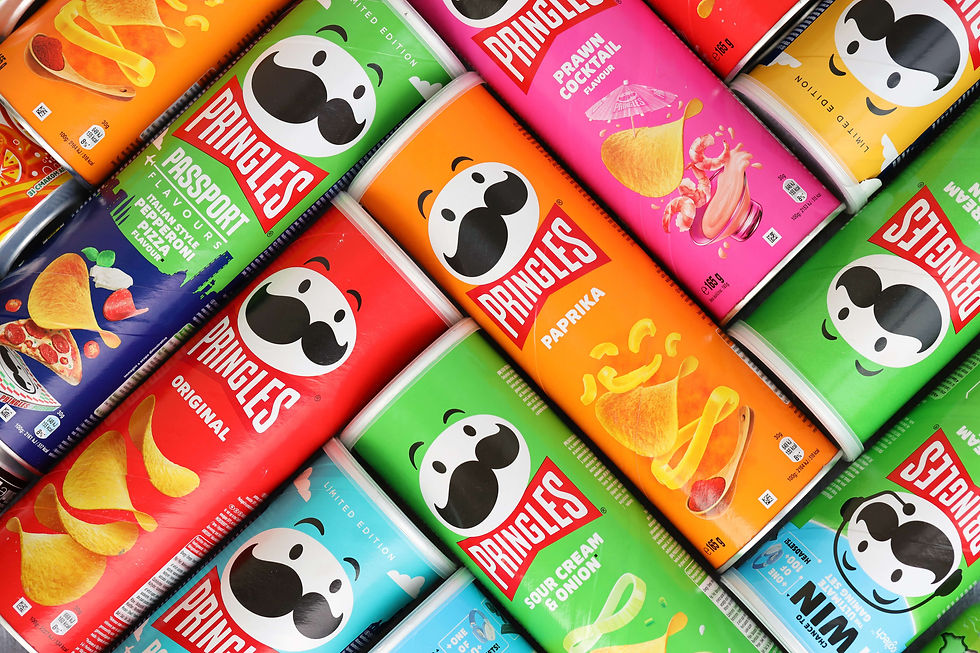
6. Pringles (Mars, Inc. / Kellanova)
The narrative surrounding Pringles in 2025 and 2026 is entirely defined by historical corporate consolidation. In early 2025, Mars, Incorporated, finalised its USD 35.9 billion acquisition of Kellanova, fundamentally altering the global snacking power dynamic and granting Mars a massive foothold in the savoury sector. Pringles is the crown jewel of this acquisition. Under Kellanova's previous stewardship, the brand was targeting USD 4 billion in global sales but was critically under-indexing in convenience and small-store channels, which accounted for only 24% of its sales volume.
Pringles occupies a unique behavioural space in the snack market. Social listening data indicates that Pringles operates with highly stable, habitual consumption patterns—showing a steady +2.2% year-over-year growth in social discussion—rather than relying on volatile, trend-driven spikes. The brand functions as a category anchor, heavily associated with informal, group-oriented consumption occasions, demonstrating deep correlation with social foods like beer brats and casual dining. Pringles' hyperbolic paraboloid shape and rigid canister packaging offer a profound logistical advantage, virtually eliminating the "slack fill" and breakage issues that plague bagged competitors, making it an ideal product for complex global export.
2026 Strategic Projection: Under the unparalleled global distribution infrastructure of Mars, Pringles will experience a distribution renaissance. By 2026, Mars will force Pringles into millions of previously untapped points of sale across emerging markets in Asia, Latin America, and Europe. The market should also anticipate unprecedented "Collision Collabs" utilising Mars' intellectual property, potentially yielding chocolate-coated Pringles or flavour profiles inspired by Mars' iconic candy brands to capture the lucrative sweet-and-salty hybrid segment.
7. Kinder (Ferrero Group)
Kinder has evolved from a beloved European speciality into a bona fide global juggernaut, serving as the primary growth engine for the Ferrero Group's EUR 19.3 billion consolidated turnover. Ferrero has deployed massive capital investments to support Kinder's aggressive global expansion. In 2025, the company unveiled a state-of-the-art, USD 214 million Kinder Bueno production facility in Bloomington, Illinois, drastically enhancing supply chain agility and increasing production capacity by 169,000 square feet within the crucial North American market.
Kinder's 2025 strategy aggressively targeted cross-category expansion and high-profile experiential marketing. The brand successfully migrated into the frozen aisle with the launch of Kinder-branded ice cream bars, securing a foothold in the premium frozen dessert category. Furthermore, Ferrero committed over USD 100 million to a landmark sports marketing campaign in the United States, positioning Kinder Bueno in Ferrero's first-ever commercial during the Big Game (Super Bowl). This unprecedented marketing spend signals a definitive, aggressive push to transition Kinder from a niche import to a ubiquitous household name across America.
2026 Strategic Projection: Kinder is perfectly positioned to be the fastest-growing confectionery brand in North America through 2026. The localised manufacturing capabilities in Illinois will completely insulate the brand from transatlantic shipping delays and European tariff risks. By heavily promoting its ice cream and refrigerated formats, Kinder will overcome the traditional summer sales slump associated with ambient chocolate, capturing highly profitable, year-round dessert occasions.
8. M&M's (Mars, Inc.)
As the flagship brand of Mars' USD 22 billion confectionery division, M&M's operates with a level of brand equity and global scale that few FMCG products can rival. The brand's cultural resonance was formally recognised in 2025 when Mars was included in the TIME World's Best Companies list, with M&M's highlighted as a key driver of the company's USD 55 billion total enterprise value.
Facing the same historic cocoa price inflation as its competitors, Mars masterfully utilised M&M's to pivot away from low-margin, high-cocoa solid chocolate bars toward high-margin, value-added formats. In 2025, product innovation centred on textural complexity and format shifting, most notably the highly successful introduction of the M&M's Peanut Butter Ice Cream Cookie Sandwich. This strategic formulation utilises lower-cost ingredients—such as dairy and baked goods—to subsidise the high cost of the chocolate components, protecting overall profit margins. M&M's also continues to dominate the experiential retail sector through its immersive global flagship stores, which drive massive direct-to-consumer revenue via high-margin customised products and branded merchandise.
2026 Strategic Projection: M&M's will further entrench itself in the "snackification" of the bakery and frozen aisles. In 2026, the brand will likely explore functional inclusions, utilising its iconic candy shell to deliver wellness-oriented benefits. Aligning with the global health and wellness structural reset, expect the launch of reduced-sugar shells or protein-fortified centres, allowing M&M's to pivot from pure indulgence to permissible, functional snacking while retaining its core identity of colourful, shareable joy.
9. Ritz (Mondelēz International)
Ritz crackers represent a highly stable, USD 1.5 billion foundational pillar within Mondelēz's global savoury portfolio. The brand is deeply woven into the fabric of American dietary habits, boasting a staggering 47% household penetration rate. Over the past six to seven years, Ritz has defied the broader commoditization of the ambient cracker category, growing its sales by nearly half a billion dollars through relentless premiumization and cultural relevance.
In 2025, Mondelēz successfully modernised the Ritz brand image through aggressive, culture-first marketing. The brand partnered with global music icon Bad Bunny to launch the "Salty Club" activation during his concert residency, seamlessly connecting a 90-year-old cracker brand with modern, diverse, youth-oriented culture. This campaign successfully pivoted Ritz's perception from a nostalgic, passive pantry staple to an active, culturally relevant lifestyle brand. Furthermore, Ritz capitalised on the premiumization trend by positioning its crackers as the ultimate high-quality, versatile canvas for premium cheeses, artisanal dips, and complex charcuterie, aligning with the "freezer fine dining" and at-home premium culinary trends dominating the market.
2026 Strategic Projection: Ritz will pivot aggressively toward the "Staple-izing of Snacks" megatrend. As consumers increasingly seek out versatile foods that can seamlessly transition from a mid-day snack to a light meal component, Ritz will expand its portfolio to include complex grains, seeds, and heightened fibre content. This aligns perfectly with the 2026 consumer mandate for gut-microbiome support and fibre-forward formulations, ensuring Ritz remains relevant to health-conscious consumers and those managing weight via GLP-1 medications.
10. Cheez-It (Mars, Inc. / Kellanova)
With roots dating back to its invention as a "baked rarebit" by the Green & Green Company in 1921, Cheez-It is an iconic American brand that is currently undergoing a massive global transformation. As a critical component of Mars' USD 35.9 billion acquisition of Kellanova, Cheez-It's future is inherently tied to rapid international expansion. Historically confined primarily to the North American market, Kellanova initiated a massive, multi-year global rollout: launching in the UK, Ireland, Germany, and Australia in 2024, followed by France and Spain in 2025, with a targeted launch in Japan slated for 2026.
Product innovation has been rapid and technologically advanced. Utilising state-of-the-art extrusion and baking methodologies, the brand launched highly successful textural variants such as Cheez-It Puff'd, Snap'd, and Grooves, catering directly to younger consumers demanding lighter, crispier textures and intense, immediate flavour delivery. Interestingly, a Piper Sandler survey revealed that teens provided 45 different spellings for the Cheez-It brand in 2025, highlighting that while brand recognition is exceptionally high, consumer engagement with the physical packaging is secondary to the immediate sensory experience of the product itself.
2026 Strategic Projection: Under Mars' stewardship, 2026 will be the year Cheez-It achieves true global scale. The brand will execute highly localised flavour profile adaptations for the Asian and European markets, potentially incorporating regional cheese varietals, umami profiles like miso, or spicy variants to meet local palates. The brand's inherent baked, real-cheese profile provides a massive authenticity halo, allowing it to easily outcompete artificially flavoured savoury snacks in regions with strict clean-label preferences.
11. Cadbury (Mondelēz International)
Cadbury operates as the undisputed linchpin of Mondelēz's European and Commonwealth confectionery dominance, contributing massively to the parent company's USD 36.4 billion in net revenues. Facing intense regulatory pressure across Europe and the UK—specifically regarding High in Fat, Salt, and Sugar (HFSS) advertising and retail placement restrictions—Cadbury has been forced to spearhead Mondelēz's clean-label and health-oriented operational reset.
Throughout 2025, Cadbury invested heavily in complex food science to develop reduced-sugar formulations of its classic Dairy Milk line and other beloved formats, striving to achieve strict regulatory compliance without compromising the brand's signature creamy sensory profile. Concurrently, Cadbury positioned itself at the vanguard of the industry's sustainability mandate. With approximately 68% of global snack manufacturers adopting eco-friendly packaging solutions, Cadbury's "Harmony" program and its public commitments to fully recyclable packaging fortified consumer trust and brand equity among environmentally conscious Millennials and Gen Z, who account for 58% of premium snack purchases.
2026 Strategic Projection: To navigate the extraordinarily high-cost cocoa environment projected to persist through 2026, Cadbury will heavily emphasise "mindful portion control." Expect a massive proliferation of single-serve, perfectly portioned formats—a segment that already saw a 10% sales growth industry-wide in 2025—designed to offer permissible indulgence at accessible price points. Cadbury will also aggressively market its transparent, ethical cocoa sourcing to justify premium pricing in an otherwise constrained market.
12. Milka (Mondelēz International)
Operating in synergistic tandem with Cadbury, Milka dominates the Alpine and broader continental European chocolate sectors. In 2025, Mondelēz executed an absolute masterclass in brand synergy and intellectual property utilisation. Mondelēz struck a strategic partnership to distribute the Lotus Biscoff brand across India while simultaneously launching highly anticipated co-branded chocolate innovations across Europe, merging the iconic Milka chocolate with the globally trending Biscoff spread.
This innovation perfectly captures the "Collision Collabs" megatrend, wherein combining two highly recognisable, beloved brands generates instantaneous consumer curiosity, immediate comprehension, and explosive viral social media traction. This strategy is exceptionally capital-efficient; it effectively bypasses the need for expensive, ground-up flavour development and extensive consumer testing by utilising proven, existing intellectual property to drive immediate retail volume.
2026 Strategic Projection: Milka will serve as Mondelēz's primary laboratory and vehicle for continued "Collision Collabs" throughout 2026. As Mondelēz expands its footprint in the USD 97 billion cakes and pastries sector, Milka chocolate will be increasingly utilised as a premium coating, filling, or inclusion in the company's rapidly expanding ambient and frozen bakery portfolio, successfully capturing the highly lucrative afternoon and post-dinner indulgence dayparts.
13. Nutella (Ferrero Group)
Nutella transcends the traditional spread category, functioning as a standalone global lifestyle brand that commands a staggering 40% market share in the worldwide chocolate spread sector. In 2025, Ferrero executed one of the most highly anticipated product launches in the brand's eight-decade history: the introduction of Nutella Plant-Based. This formulation successfully captures the surging, lucrative demand for vegan, flexitarian, and dairy-free alternatives without alienating the brand's massive legacy consumer base.
Furthermore, Ferrero aggressively pushed Nutella into the frozen and ambient bakery categories, launching Nutella-filled croissants, crepes, and doughnuts. This strategic expansion is transformational; it transitions Nutella from an ingredient applied by the consumer at home into a ready-to-eat, ultra-convenient premium snack format, significantly increasing the frequency of consumption occasions. To support this massive categorical expansion, Ferrero substantially enhanced production capacity at the Villers-Écalles plant in northern France, the world's largest Nutella production site.
2026 Strategic Projection: Nutella is poised to completely monopolise the sweet breakfast and mid-morning snacking occasions globally. The plant-based variant will allow the brand to capture the rapidly growing flexitarian demographic at a premium price point. Nutella's evolution into a comprehensive, multi-format bakery and lifestyle brand will be fully realised by late 2026, insulating it from competitors attempting to enter the core spread market.
14. Ferrero Rocher (Ferrero Group)
Positioned meticulously at the pinnacle of mass-market luxury, Ferrero Rocher relies on a highly selective distribution model that preserves its premium cachet and exclusivity. This strategic positioning uniquely insulates the brand from the day-to-day margin erosion and price wars that plague the broader salty snack and mainstream confectionery sectors, allowing it to operate primarily as an unassailable gifting and seasonal powerhouse.
In 2025, Ferrero Rocher executed highly successful, experiential travel retail activations, most notably the "Celebrations Begin with a Golden Gift" campaign deployed at major international transit hubs like Paris Orly and King Abdulaziz International Airport. These high-visibility marketing pushes—featuring bespoke gift-wrapping experiences, physical pyramid displays, and photo opportunities—drove massive consumer engagement. The activation successfully propelled Ferrero Rocher into the top ten best-selling brands across all retail categories at Paris Orly during the peak December travel season.
2026 Strategic Projection: Ferrero Rocher will double down heavily on its experiential retail and premium direct-to-consumer digital channels. As global wealth dynamics shift, the brand will aggressively target the expanding emerging middle classes in Asia and the Middle East. By utilising highly localised, culturally resonant seasonal packaging (tailored for events like Lunar New Year, Diwali, and Eid), Ferrero Rocher will drive sustained, high-margin volume year-round, breaking free from its traditional reliance on Western winter holidays.
15. Takis (Grupo Bimbo / Barcel)
Takis operates as the definitive disruptor brand of the decade. Originating in Mexico and exploding in popularity across North America and Europe, the brand has surpassed USD 1 billion in global retail sales purely on the back of its extreme, uncompromising flavour profiles. Takis explicitly and unabashedly caters to the youth demographic's insatiable demand for high-intensity, multi-sensory, and "challenge-based" consumption experiences.
In 2025, Barcel aggressively expanded the Takis flavour architecture—most notably its signature "Fuego" (lime and chilli) profile—across entirely new physical formats. The introduction of Takis Waves, Takis Watz, and Takis Hot Nuts transformed the brand from a single rolled-tortilla product into a comprehensive, multi-category spicy snacking platform. The Hot Nuts line was a particular triumph, experiencing a 15.2% year-to-date sales increase, driven by a proprietary "double crunch" technology that physically and auditorily differentiates the product from legacy nut brands. Takis further gamified the snacking experience by introducing a highly visual "Heat-O-Meter" on its packaging, encouraging social media sharing and peer challenges.
2026 Strategic Projection: Takis will force a categorical arms race in extreme flavour intensity across the entire global snacking industry. In 2026, expect Takis to further encroach on PepsiCo's historical dominance by expanding its product architecture into extruded snacks and potentially spicy meat formats. The brand will continue to heavily leverage TikTok and other short-form video platforms where viral, organic marketing drives exponential volume growth without the need for traditional television ad spend.
Strategic Outlook for Food and Beverage Professionals
The global snacking industry in 2026 will be defined by an intense, zero-sum battle for the "Share of Stomach" in an operational environment where traditional meal times have thoroughly disintegrated. To thrive in this highly consolidated, USD 1.3 trillion market, FMCG professionals, R&D scientists, and brand marketers must internalise the following operational mandates:
First, the industry must embrace the total "Staple-ization" of snacks. Snacks must be reformulated and actively marketed not as ancillary, guilt-inducing indulgences, but as viable, nutritionally dense meal replacements. Innovations must prioritise heavily functional ingredients—specifically bioavailable protein, prebiotics, and adaptogens—to align with the massive demographic shift brought on by GLP-1 therapies and the global focus on preventative health.
Second, brands must execute rigorous barbell pricing strategies. To combat the 53% of consumers actively transitioning to private label alternatives, top brands must offer hyper-affordable, smaller portion-controlled packs to retain low-income consumers. Simultaneously, they must launch ultra-premium, experiential, and functionally fortified variants to capture high-margin revenue from less price-sensitive demographics. The 15% price cut executed by PepsiCo across its core Frito-Lay brands signals that the era of relentless price-taking is over; volume defence is now the priority.
Third, professionals must leverage "Collision Collabs" and deep cultural resonance. Breakthrough innovation in 2026 does not necessarily require novel food science from the ground up. As demonstrated by Mondelēz with the Milka/Biscoff integration and the Ritz/Bad Bunny partnership, merging established intellectual property or embedding a legacy brand deeply within modern cultural touchpoints (such as global gaming networks or international music tours) generates instantaneous, high-conversion consumer curiosity and massive digital earned media.
Finally, capital must be relentlessly directed toward supply chain localisation. The era of the highly vulnerable, globally extended supply chain is concluding. Investments must be channelled into localised, automated manufacturing hubs that allow brands to rapidly and agilely adapt to hyper-local flavour trends while physically protecting the enterprise against global commodity spikes and logistics volatility. The brands that will dominate the remainder of the decade are those capable of mastering this duality: delivering the profound emotional comfort of a legacy snack while engineering the nutritional functionality and operational agility of a modern, data-driven food technology enterprise.