


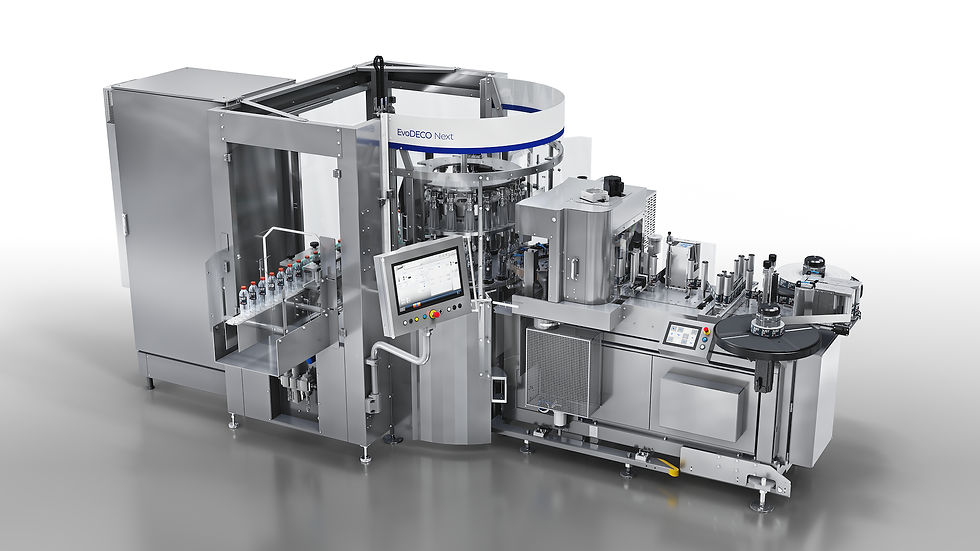
Packaging machinery manufacturer Sidel has unveiled EvoDECO Next, a next-generation roll-fed labelling solution engineered to reduce material consumption while expanding container decoration options for high-volume packaging lines.
The platform integrates partial-labelling capabilities into a roll-fed mechanical architecture, allowing beverage, food, and home-care manufacturers to transition away from full-wrap labels without reducing line speed or operational efficiency.
The introduction supports Sidel's broader "JUST label" initiative, an equipment and design framework aimed at improving sustainability credentials, lowering total cost of ownership (TCO), and streamlining mechanical maintenance across bottling operations.
"EvoDECO Next rethinks what is possible with roll-fed labelling," said Anne Philippe Lafon, Product Manager for Labelling at Sidel. "Producers no longer need to choose between industrial efficiency, material reduction and impactful decoration. By enabling partial labels on a simplified roll-fed architecture, we can help customers use less material, create new brand opportunities and maintain the performance their production lines demand."
Partial Labelling and Material Reduction
A central feature of the EvoDECO Next system is its ability to apply partial labels accurately at commercial production speeds, reducing raw packaging consumption.
Depending on the container profile and visual design requirements, partial labelling can decrease total label surface area by up to 75% compared with traditional 360-degree wraparound formats:
90-Degree Partial Configuration: Yields up to a 75% reduction in label surface area.
180-Degree Partial Configuration: Delivers an approximate 50% reduction in label material.
For high-speed, continuous-run bottling operations, these material reductions translate into measurable operational savings. According to production modelling conducted by Sidel, switching an industrial line from standard wraparound labels to a 90-degree partial label configuration can reduce biaxially oriented polypropylene (BOPP) plastic consumption by 208.4 tonnes per year.
This raw material reduction corresponds to an annual carbon footprint reduction of 346 tonnes of CO2 equivalent and approximately €723,000 in direct material input cost savings.
Integrated Platform Architecture
Rather than modifying existing roll-fed equipment to handle shorter film formats, Sidel engineered EvoDECO Next as a purpose-built, integrated system. The machinery layout synchronises film feeding, cutting, transfer, and vision inspection to prevent tension disruptions or misfeeds:
Cutter 2.0: The proprietary cutting system is positioned directly on the transfer drum. The rotary assembly utilises two high-speed blades to slice shorter label lengths rapidly while preserving edge clean-cuts.
Smart Buffer: A film-buffering module designed to absorb reel changes without slowing production line velocity. The compact mechanism operates within the machine's standard footprint, allowing automated splicing to take place at nominal line speed without causing container jams or speed drops.
Smart Camera: An advanced optical inspection unit that enables reference-mark-free label management. By eliminating the need for conventional eye marks and surrounding quiet zones on printed film, the system increases printable surface efficiency and unlocks additional film savings.
Automated Diagnostic Software: The control platform includes integrated auto-correction, enhanced homing protocols, and real-time mechanical diagnostics to streamline high-speed changeovers between varied bottle formats.
Packaging Efficiency and Performance
The debut of EvoDECO Next comes as commercial packaging producers face regulatory and corporate pressures to reduce virgin plastic volumes and secondary packaging footprints.
By addressing historical technical bottlenecks associated with handling lightweight, short-format films on high-throughput rotary drums, Sidel enables packaging lines to adopt minimalist label designs while preserving line efficiencies and operational throughput.
EvoDECO Next is available for integration across new bottling lines or as an upgrade platform for industrial liquid packaging facilities globally.


Indian Food Regulator Enforces 90-Day Energy Drink Label Removal Deadline
WK Kellogg Co Launches 'Spoons' Nutrition Labelling Framework

POS Supply Solutions Launches QuickStick Foodservice Labelling Line
