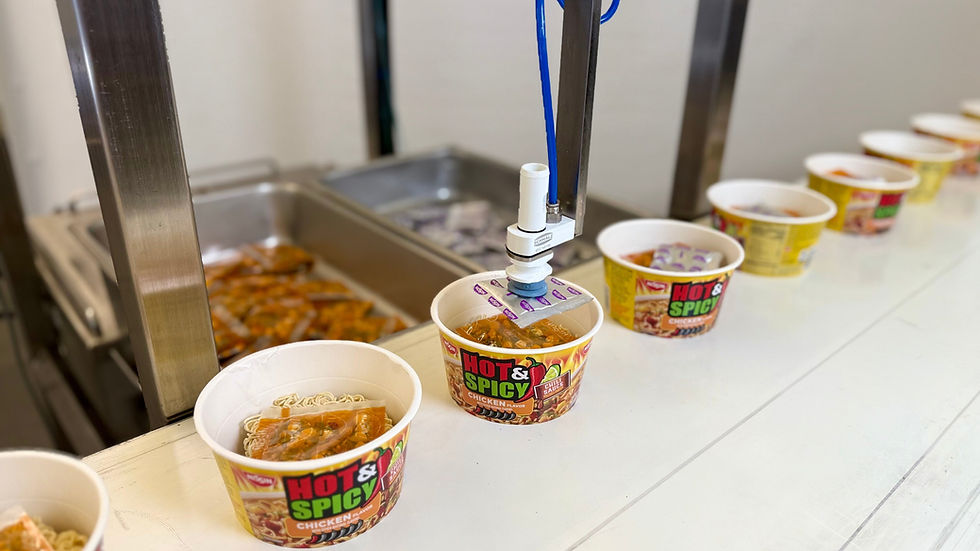
Chef Robotics, a leader in the application of physical AI for the food industry, has announced the launch of a new capability designed to automate secondary packaging and kitting for Consumer Packaged Goods (CPG) lines. The application is engineered to handle discrete, irregular items, such as sauce sachets, seasoning packets, and cutlery kits, transitioning a historically manual process into an automated, data-driven workflow.
The move addresses a primary bottleneck in the CPG supply chain: the high labour dependency required to manage lightweight, deformable components that traditional "rigid" automation systems struggle to identify and manipulate.
Solving the Variability Bottleneck in Kitting
Unlike whole produce or rigid containers, items like foil-sealed pouches and plastic-wrapped cutlery are notoriously difficult to automate. These components are lightweight, flat, and frequently shift or crinkle in their source bins. This "pose variability" has traditionally left manufacturers reliant on manual labour to ensure accurate placement at production speeds.
To resolve this, Chef Robotics has integrated its existing piece-picking technology with advanced physical AI models. These models are trained across diverse production environments, allowing the robots to assess the position, shape, and orientation of every item in real-time. This "agentic" vision system determines the optimal pick-and-place strategy to ensure items are nested precisely within cups, bowls, or trays without damaging the packaging or the contents.
Technical Placement Capabilities
The CPG assembly application introduces three distinct functional pillars that differentiate it from legacy pick-and-place hardware:
Mid-Pick Reorientation: The vision system detects the specific angle of an item in the bin and reorients the robotic arm during the transit phase. This ensures that sachets or instruction cards arrive at the exact angle required for the SKU, regardless of how they were originally oriented in the unstructured source container.
Multi-Component Pass: The robots are programmed to pick and place multiple components, such as several different seasoning sachets for an instant ramen bowl, in a single automated pass. This eliminates the need for human intervention between picks and significantly increases line throughput.
Multi-Compartment Precision: For complex products like global meal kits or divided snack trays, the AI vision model detects the position of individual compartments in real-time. This ensures that specific items (e.g., a bread accompaniment or a desiccant packet) are placed in the correct section without migrating into adjacent areas.
Integration and RaaS Economics
A primary commercial advantage for food manufacturers is that the CPG assembly application runs on Chef’s existing robotic hardware and software. This allows organisations to deploy the technology without requiring a significant overhaul of their existing line infrastructure.
Furthermore, the capability is offered through a Robotics-as-a-Service (RaaS) pricing model. By transitioning automation from a capital expenditure (CapEx) to an operational expenditure (OpEx), Chef Robotics is lowering the barrier to entry for mid-sized manufacturers and allowing large-scale operators to scale their automation capacity in direct alignment with market demand.