Search Results
Search this site
2925 results found with an empty search
- Monster Energy Launches Oscar Piastri Limited Edition Cans | FNBX
Limited-edition Monster Energy cans featuring Formula 1 driver Oscar Piastri, aiming to drive category engagement in the UK energy drink sector. comments debug Exchange Write a comment Write a comment Share Your Thoughts Be the first to write a comment. Featured in this news Energy Drinks Monster Beverage Corp The Newsroom Never Miss an Update! Receive personalised weekly email newsletters with industry news curated just for you. Email* Submit or create an account to access more > Coca-Cola Europacific Partners (CCEP) has introduced a new range of limited-edition Monster Energy cans featuring Formula 1 driver Oscar Piastri. The release, which arrives on 29 June, covers both Monster Energy Original and Monster Energy Zero Sugar variants, aiming to leverage interest in the sport to drive sales within the energy drink category. This initiative follows the recent introduction of the Monster Energy Lando Norris Gold Can, reflecting the brand’s ongoing association with Formula 1. The cans are being distributed across wholesale, convenience, and grocery channels in both plain and price-marked pack (PMP) formats. The energy drink category remains a significant segment for retailers, valued at over £2.5 billion in Great Britain. Within this, the low-calorie energy segment accounts for more than £631 million. Monster Energy currently holds a 55% share of the low-calorie energy segment, positioning the brand to influence demand for zero-sugar options. The rollout of the limited-edition range is intended to generate engagement at the fixture, providing retailers with a seasonal product intended to capture consumer interest through collectability. Retailer Support and Visibility CCEP has stated that the product launch is supported by a range of materials designed to facilitate in-store execution and visibility: Point of Sale (POS): Customised materials are available for retailers to create high-impact displays. Digital Assets: Supporting content is available through the MyCCEP.com portal. Rob Yeomans, Vice-President, Commercial Development at CCEP GB, noted that the launch is intended to reinforce the brand's connection with Formula 1. He advised that retailers should ensure the limited-edition packs are highly visible in chillers and displays while stocks remain available. Monster Energy Launches Oscar Piastri Limited Edition Cans June 29, 2026 Energy Drinks Celsius Unveils Spritz Vibe Winter Edition with Sparkling Shirley Temple New Products Switch Energy Drink Launches Limited Edition Bite Me Halloween Flavour Energy Drinks Red Bull Launches The Glacier Edition Frosted Raspberry Flavour in UK Energy Drinks Monster Unveils Protein Energy Hybrid Beverage Line with 30g Protein Energy Drinks New Products Beverage Related news
- Ghirardelli Launches Milk Chocolate Chip Brownie Mix for Retail | FNBX
Ghirardelli has expanded its premium baking portfolio with the debut of its first Milk Chocolate Chip Brownie Mix, targeting a $4.25 price point and leveraging its "professional" grade chocolate chips to capture a broader segment of the at-home baking market. comments debug Exchange Write a comment Write a comment Share Your Thoughts Be the first to write a comment. The Newsroom Never Miss an Update! Receive personalised weekly email newsletters with industry news curated just for you. Email* Submit or create an account to access more > The Ghirardelli Chocolate Company has announced a significant expansion of its retail baking lineup with the introduction of the Milk Chocolate Chip Brownie Mix. This launch marks the first time the company has integrated a milk chocolate profile into its flagship brownie category, a move designed to capture a consumer segment that prioritises a sweeter, creamier chocolate profile over the brand's traditional dark chocolate offerings. The 17-oz. pouch is positioned as a premium, low-labour solution for the spring gathering season, requiring only standard pantry staples (water, oil, and egg) to produce an 8x8-inch pan of "ultra-rich" brownies. Historically, Ghirardelli’s brownie portfolio has been defined by dark and semi-sweet chocolate profiles, aligning with the brand’s reputation for intense cocoa experiences. However, the introduction of a milk chocolate variant signals a strategic pivot to address the "craveable" flavour profile preferred by a large portion of the North American confectionery market. David Dulyx, Vice President of Licensing and Professional Products Division for Ghirardelli, noted that the product was "reimagined" to deliver a batch specific to milk chocolate lovers. By utilising the same high-quality milk chocolate chips found in its professional and confectionery divisions, the company is maintaining its "premium" brand equity while lowering the barrier to entry for more casual bakers. Product and Profile The Milk Chocolate Chip Brownie Mix is engineered to deliver a specific textural contrast that has become a benchmark for premium packaged mixes: Core Texture: A fudgy, moist centre achieved through a high-fat-to-flour ratio. Structural Finish: Targeted "crisp edges" that mirror artisanal bakery standards. Flavour Profile: A combination of rich cocoa, silky-sweet milk chocolate chips, and a subtle vanilla finish. This "indulgent experience" is intended to serve the "permissible indulgence" market, where consumers are willing to pay a premium, currently set at a $4.25 starting price, for a guaranteed high-quality result from a trusted heritage brand. Retail Distribution To ensure maximum visibility during the critical spring retail window, Ghirardelli has secured early placement with several dominant regional and national grocery chains. The rollout strategy includes: Initial Availability: H-E-B and the Kroger Family of Stores (including Ralphs and Fred Meyer). Secondary Phase: A nationwide expansion to Target and other mass merchandisers later in the spring of 2026. Pricing Strategy: Positioned at a starting price of $4.25, placing it at the top-tier of the dry baking mix aisle. Industrial Significance and Outlook For B2B stakeholders and retail category managers, the launch of the Ghirardelli Milk Chocolate Chip Brownie Mix represents an effort to drive "trade-up" behaviour in the baking aisle. As private label and value-tier brands dominate standard brownie mixes, premium players like Ghirardelli must differentiate through specialised flavour profiles and the inclusion of branded ingredients (such as the signature chips). As the home baking market continues to professionalise, industry observers expect Ghirardelli to continue leveraging its "Licensing and Professional Products" expertise to bridge the gap between industrial-grade chocolate and the consumer pantry. The success of this milk chocolate variant may lead to further portfolio diversification into other non-dark chocolate baking categories throughout 2026. Ghirardelli Launches Milk Chocolate Chip Brownie Mix for Retail April 1, 2026 New Products Nestlé Toll House Launches First Advent Calendar for Holiday Baking Bakery Puratos Launches ProteinPro Clean-Label Bakery Mixes New Products Nestlé Launches Dessert Culinary Solutions in Brazil and China Bakery Betty Crocker Unveils Packaging Refresh and Limited Edition Handbag Collection Bakery New Products Snacking Related news
- Mars and ofi Partner to Scale Regenerative Cocoa Farming in Ecuador | FNBX
Mars and ofi have announced a five-year strategic collaboration to implement climate-smart and regenerative agriculture practices across 9,000 hectares of cocoa farmland in Ecuador, aiming to reduce greenhouse gas emissions and enhance farmer resilience. comments debug Exchange Write a comment Write a comment Share Your Thoughts Be the first to write a comment. Featured in this news Ingredients ofi (Olam Food Ingredients) Featured in this news Confectionery Mars Inc The Newsroom Never Miss an Update! Receive personalised weekly email newsletters with industry news curated just for you. Email* Submit or create an account to access more > Mars, Incorporated and ofi (Olam Food Ingredients) have launched a five-year strategic collaboration running from 2025 to 2029. The partnership is designed to advance climate-smart and regenerative agriculture practices within the companies' shared cocoa supply chain in Ecuador. The collaboration builds on more than 15 years of joint sustainable cocoa sourcing globally and a decade of specific cooperation within the Ecuadorian market, aligning the resources of two major global ingredients and confectionery players. Agroforestry Transition and Scale The initial phase of the project targets more than 960 farmers across major Ecuadorian cocoa-growing regions, including El Oro, Esmeraldas, Guayas, Los Ríos, Manabí, and Santo Domingo. In total, the initiative covers more than 9,000 hectares of farmland. The core operational shift involves transitioning farmers from full-sun monoculture to multistrata agroforestry. By mimicking natural forest ecosystems, these diversified systems are designed to boost overall cocoa production, support local microorganisms and pollinators, and create natural, biological barriers against pests and disease. Technical Interventions and Soil Health In addition to structural agroforestry changes, participating farmers will receive the tools and training necessary to implement specific climate-smart interventions at the farm level. These include: Low Carbon Fertilisers 🌱 Reducing the reliance on traditional synthetic inputs that contribute heavily to the agricultural supply chain emissions. Biochar Applications 🪵 Utilising biochar to enhance soil health, improve water retention, and increase long-term carbon sequestration (CO2 removals). Crop Residue Management 🍂 Improving organic matter recycling to build more resilient, nutrient-dense soil profiles. These interventions collectively aim to enhance long-term farming resilience and boost cocoa crop yields. By making these practices more accessible and offsetting the costs of new inputs, the partnership opens up new income opportunities for producers. The companies estimate that approximately 4,800 people in the surrounding cocoa-growing communities will benefit from these on-farm investments. Shared Net Zero Ambitions and SBTi Alignment The collaboration is underpinned by the shared climate ambitions of both organisations. Both Mars and ofi maintain Net Zero 2050 commitments that have been validated by the Science Based Targets initiative (SBTi). Benjamin Guilbert, Global Vice President of Cocoa at Mars, stated that the effort demonstrates how shared common goals can drive meaningful impact at scale, supporting a more modern, inclusive, and sustainable cocoa ecosystem. Andrew Brooks, Head of Cocoa Sustainability at ofi, noted that scaling up practices like biochar and agroforestry aims to cut greenhouse gas emissions while simultaneously securing the future supply of cocoa. Pedro Amaral, Associate Director and Head of Cocoa Climate Sustainability at Mars, added that having SBTi-validated ambitions enables a bold framework for the companies to co-invest in long-term solutions that benefit the farmers, the environment, and the future viability of the supply chain. Mars and ofi Partner to Scale Regenerative Cocoa Farming in Ecuador April 17, 2026 Agriculture Lubrizol Launches ZYRA Product Family for Agricultural Formulations Agriculture Syngenta and Kyoyu Agri Collaborate on Novel Rice Herbicide New Solutions IFF Launches Omni-Bos PHY Phytase Enzyme to Improve Dairy Feed Efficiency Agriculture Beanstalk AgTech Launches Monsoon Ventures to Scale Southeast Asian Agtech Ingredients Business & Finance Agriculture Sustainability Related news
- Fresh Del Monte Partnership with Toy Story 5 | FNBX
Fresh Del Monte is leveraging the global release of Toy Story 5 to distribute 600 million co-branded stickers and hangtags. comments debug Exchange Write a comment Write a comment Share Your Thoughts Be the first to write a comment. Featured in this news Food Fresh Del Monte The Newsroom Never Miss an Update! Receive personalised weekly email newsletters with industry news curated just for you. Email* Submit or create an account to access more > Fresh Del Monte Produce Inc. has announced a landmark strategic collaboration with Disney and Pixar to coincide with the theatrical release of Toy Story 5 on 19 June 2026. The worldwide campaign represents a significant effort to inject high-equity entertainment intellectual property (IP) directly into the fresh produce section, utilising characters like Woody, Buzz Lightyear, and Jessie to drive volume and encourage healthy dietary habits among families. The initiative involves the deployment of more than 600 million co-branded banana stickers and pineapple hangtags across global retail networks, turning everyday fruits into interactive marketing touchpoints. Packaging Campaign Fresh produce has traditionally been a low-margin, commodity-driven category where brand differentiation is difficult to maintain. By partnering with a major global entertainment franchise, Fresh Del Monte is transforming its core products into high-impulse purchases. The campaign features custom-designed, co-branded packaging across three of the brand's primary product lines: Del Monte Bananas: Featuring character-themed stickers designed to capture the attention of younger shoppers. Del Monte Gold Pineapples: Utilising custom hangtags that serve as a canvas for both character art and digital activation keys. Honeyglow Pineapples: Bringing premium, sustainably grown pineapples into the promotional loop to target the premium-value grocery segment. The specialised packaging is available across all participating international regions, with in-store and online distribution scheduled to run through 31 July 2026. Marketing Mechanics and Engagement To support the physical rollout, Fresh Del Monte is implementing a comprehensive digital and experiential marketing campaign. Rather than relying solely on passive in-store displays, the strategy focuses on driving consumers from the physical produce aisle to the brand's digital ecosystem. A central component of this engagement is the Barcelona Sweepstakes . By scanning the QR codes featured on the co-branded stickers and hangtags, or by visiting a dedicated campaign portal, consumers can enter to win a five-night family trip to Barcelona, Spain. The curated prize package includes: Educational Visits: Tickets to Barcelona's famous Science Museum. Cultural Excursions: Guided horseback tours in Montserrat and visits to local colourful parks and gardens. Experiential Treats: Interactive local culinary experiences, including artisanal gelato tastings. This digital entry point is supplemented by a robust social media campaign on Instagram, featuring custom recipes, interactive games, and regular giveaways of official movie merchandise and theatrical tickets, maintaining high digital engagement throughout the peak summer trading window. Fresh Produce & Entertainment For fresh produce marketers, the primary operational challenge is finding ways to make healthy snacking appealing to children who are continuously exposed to highly processed, sugar-laden snack alternatives. By partnering with an entertainment powerhouse, Fresh Del Monte is successfully leveraging character affinity to build positive associations with whole foods. Ivan Brown, Senior Director of Marketing for Fresh Del Monte in North America, stated that the organisation is honoured to collaborate with the Toy Story franchise. Brown emphasised that the campaign aims to make fresh fruit a priority in everyday adventures, helping to instil healthier habits for families by creating memorable experiences in the supermarket aisles. This strategic alignment is essential for modern retailers. By placing high-affinity characters in the fresh produce section, stores can capture the "pester power" of children and convert it into healthy shopping decisions, driving higher basket value for the perimeter of the store. Fresh Del Monte Marketing Partnership with Disney's Toy Story 5 May 18, 2026 Marketing Just Shrimp Launches Shrimpmas Retail Campaign Confectionery Snickers and Adidas Partner on Limited-Edition Football Cleat Dairy Arla Foods UK Launches Feed Life Masterbrand Marketing Platform Marketing TRIP Launches Global TV and Billboard Campaign with Kendall Jenner and Joe Jonas Marketing Fresh Produce Business & Finance Related news
- Coca-Cola Introduces Limited-Time Holiday Creamy Vanilla Flavour | FNBX
For the first time in five years, The Coca-Cola Company is adding a new limited-edition flavour to its festive lineup: Coca-Cola Holiday Creamy Vanilla. comments debug Exchange Write a comment Write a comment Share Your Thoughts Be the first to write a comment. Featured in this news Beverage Coca-Cola Company The Newsroom Never Miss an Update! Receive personalised weekly email newsletters with industry news curated just for you. Email* Submit or create an account to access more > For the first time in five years, The Coca-Cola Company is adding a new limited-edition flavour to its festive lineup: Coca-Cola Holiday Creamy Vanilla. The seasonal innovation offers a twist on the classic beverage, blending the familiar taste of Coca-Cola with rich, creamy vanilla notes crafted to evoke the nostalgia and comfort of winter gatherings. The flavour will also be available in a Zero Sugar variant, giving consumers a lighter option without compromising indulgence. “Coca-Cola Holiday Creamy Vanilla celebrates the joy and nostalgia of the season while giving fans a refreshing new way to enjoy the brand they love,” a company spokesperson said. Described as a “delicious taste of Coca-Cola infused with smooth, creamy vanilla,” the launch marks the brand’s first limited-time holiday flavour since 2020. Coca-Cola Holiday Creamy Vanilla begins rolling out today (3 November) across the US and Canada, available in multiple formats including 12 oz cans (12-pack), 20 oz bottles, and 2-litre bottles. The product will be offered at major national retailers and online through the holiday season, while supplies last. Coca-Cola Introduces Limited-Time Holiday Creamy Vanilla Flavour November 4, 2025 New Products Pepsi Debuts Limited-Edition Vanilla & Cream Flavour New Products Sara Lee Debuts Limited Edition Mike's Hot Honey Half Loaf Beverage BERO Brings Back Spider-Man Branded Beer Cans Foodservice Wingstop Relaunches Carolina Gold and Jamaican Jerk for Flavour Rodeo Campaign Soft drinks New Products Beverage Related news
- Orkla Snacks Acquires The European Candy Group for €207M | FNBX
Orkla Snacks has agreed to acquire 100% of The European Candy Group B.V. for an enterprise value of €207 million to scale manufacturing. comments debug Exchange Write a comment Write a comment Share Your Thoughts Be the first to write a comment. The Newsroom Never Miss an Update! Receive personalised weekly email newsletters with industry news curated just for you. Email* Submit or create an account to access more > Nordic confectionery company Orkla Snacks has reached an agreement to acquire 100 per cent of the shares in The European Candy Group B.V. (CCI), a European manufacturer of vegan sugar confectionery. The transaction assigns CCI an enterprise value of €207 million on a cash- and debt-free basis. The selling group comprises funds managed by private equity firm Bencis Capital Partners alongside CCI management shareholders. The acquisition is structured to provide Orkla Snacks with additional processing infrastructure to support the ongoing growth of its BUBS confectionery brand across Nordic markets, while establishing manufacturing capacity to accelerate expansion across continental Europe. Production Capacity and Performance CCI has served as a co-manufacturing partner for selected BUBS confectionery lines since 2025. The company operates four manufacturing facilities, including three plants in the Netherlands and one site in Germany. Key operational metrics and financial forecasts for the transaction include: 💶 Enterprise Valuation: €207 million on a cash- and debt-free basis. 📈 Revenue Forecast: Projected to generate approximately €110 million in revenue during 2026, up from €94 million reported in 2025. 📊 Earnings Profile: Expected to deliver an adjusted EBITDA of approximately €21 million for the 2026 financial year. 🏭 Manufacturing Infrastructure: Four production plants across the Netherlands and Germany, backed by a workforce of more than 300 employees. Ingvill T. Berg, Chief Executive Officer of Orkla Snacks, stated that the transaction aligns with the company's regional growth framework, adding that integrating CCI's manufacturing capability and retailer distribution network will strengthen Orkla Snacks' European footprint and support BUBS' entry into new geographical markets. Portfolio Integration Following completion of the deal, Orkla Snacks plans to maintain CCI's core private-label and branded supply agreements while progressively reallocating production lines to increase BUBS output for high-demand export channels. Based in Drachten, the Netherlands, CCI manufactures private-label confectionery, liquorice, and sugar-free items for grocery, pharmacy, and online retail networks across Europe. The transaction remains subject to customary regulatory approvals and mandatory consultation with Dutch works councils. Closing is anticipated toward the end of the third quarter or early in the fourth quarter of 2026. Orkla Snacks: Operating as a portfolio company of Norwegian investment major Orkla ASA, Orkla Snacks holds market positions across confectionery, biscuits, and salty snacks in the Nordic and Baltic regions. The enterprise reported total turnover of NOK 10.5 billion in 2025. Orkla ASA: Headquartered in Oslo and listed on the Oslo Stock Exchange, Orkla ASA operates as an industrial investment company managing ten consumer-oriented portfolio businesses. The group recorded annual turnover of NOK 71.5 billion in 2025. Orkla Snacks Acquires The European Candy Group for €207M August 1, 2026 New Products Oatly Launches High-Fibre Oat Drink Range in UK Plant-based Impossible Foods Launches Four Frozen Lines in Tesco UK Stores New Products Ripple Foods Launches Plant-Based Toddler Milk New Products La Vie Launches Meat Alternative Flavoured Tofu Range Plant-based Confectionery Facilities Business & Finance Related news
- BLNCD Naturals and Foundry Nation New Low THC Range | FNBX
BLNCD Naturals and Foundry Nation have unveiled a cannabis beverage collection featuring 0.4mg of hemp-derived THC comments debug Exchange Write a comment Write a comment Share Your Thoughts Be the first to write a comment. The Newsroom Never Miss an Update! Receive personalised weekly email newsletters with industry news curated just for you. Email* Submit or create an account to access more > BLNCD Naturals and Foundry Nation have expanded their portfolio with a new cannabis-infused beverage collection. The range features a low-dose 0.4mg hemp-derived THC content, paired with cannabinoids such as CBG and CBD, as well as functional adaptogens. The launch is intended to address shifting consumer demand for ingredient-focused, lower-potency formulations. The development of this collection departs from a focus on THC potency, instead prioritising the interaction between minor cannabinoids, terpenes, and functional ingredients. According to the brand, this approach is designed to create specific consumer experiences based on occasion and preference. By incorporating ingredients such as Lion’s Mane, Rhodiola, Ashwagandha, Reishi, and Chaga, the brands aim to position these beverages within the functional drink category rather than as traditional high-potency cannabis products. This strategy is also a response to the evolving regulatory landscape surrounding hemp-derived products, allowing the companies to remain active in the sector while aligning with varied consumer comfort levels. Collection Details The collection spans several distinct product offerings under the BLNCD Naturals and Foundry Nation banners, each targeted at different usage scenarios. BLNCD Naturals Range 🍐 Prickly Pear Bee's Knees Cannabis Mocktail: 0.4mg THC, 10mg CBG, and Sativa terpenes. 🧠 Brain Boost Functional Cannabis Elixir: 0.4mg THC, 10mg CBG, Lion's Mane, Rhodiola, Ashwagandha, Agave Inulin, and Sativa terpenes. 🧘 Zen Blend Functional Cannabis Elixir: 0.4mg THC, 10mg CBD, Reishi, Chaga, Ashwagandha, Agave Inulin, and Indica terpenes. Foundry Nation Range 🍋 Lemon Haze Cannabis Soda: 0.4mg THC, 10mg CBG, and strain-specific Sativa terpenes. 🍓 Strawberry Diesel Cannabis Soda: 0.4mg THC, 10mg CBG, and strain-specific Sativa terpenes. 🍇 Granddaddy Purple Cannabis Soda: 0.4mg THC and strain-specific Indica terpenes. Market Positioning The management team has indicated that the formulation philosophy remains consistent with their past product development, which emphasises transparency in ingredient lists. By focusing on recognisable functional ingredients, the brands aim to capture consumers who may be seeking the effects of cannabinoids without the intensity often associated with higher THC dosages. The beverages are scheduled to be available through select retail partners and online channels, subject to ongoing market rollout plans and regulatory developments. BLNCD Naturals and Foundry Nation Launch Low THC Beverage Line June 30, 2026 New Products Khalifa Kush Partners with Scofflaw Brewing to Launch THC Beverages Legal US Senate Proposed Legislation Delays Hemp THC Beverage Ban Business & Finance Foundry Nation Announces Portfolio Refresh and New THC Formulations New Products Craft and Art Wine and Spirits Enters THC Beverage Market With Woodstock Beverage New Products Ingredients Related news
- UK Sugar Tax Extension and Its Implications for the Food and Beverage Industry | FNBX Analysis
The UK government has announced a significant extension to the Soft Drinks Industry Levy (SDIL), commonly referred to as the sugar tax, now encompassing high-sugar milk-based drinks. Analysis UK Sugar Tax Extension and Its Implications for the Food and Beverage Industry This move, effective from 1 January 2028, expands the levy beyond traditional soft drinks to include pre-packaged milk-based and milk alternative beverages with added sugar, such as flavoured milks, milkshakes, sweetened yoghurt drinks, and ready-to-drink (RTD) coffees. November 28, 2025 Go Related News Never Miss an Update! Receive personalised weekly email newsletters with industry news curated just for you. Email* Submit or create an account to access more > The UK government has announced a significant extension to the Soft Drinks Industry Levy (SDIL), commonly referred to as the sugar tax, now encompassing high-sugar milk-based drinks. The extension represents a notable shift in regulatory focus and carries profound implications for manufacturers, retailers, and consumers alike. Here, we explore the expected impact on the UK food and beverage sector, drawing on data trends, industry commentary, and policy objectives. 1. Background: The Soft Drinks Industry Levy Introduced in April 2018, the SDIL was designed to reduce sugar consumption in soft drinks. It targets manufacturers and importers rather than consumers directly, incentivising product reformulation. Since its introduction: The average sugar content in drinks within scope has fallen by nearly 50% . Many manufacturers halved sugar levels in flagship products to avoid levy charges. The policy has been credited with influencing healthier consumer choices without significantly affecting sales volumes. Historically, milk-based drinks with added sugar were exempt from the levy despite containing sugar levels comparable to fizzy drinks, often added directly during production. This extension seeks to close that gap. 2. Scope and Threshold Changes The new levy extension introduces the following changes: Threshold reduction: Drinks with sugar content exceeding 4.5g per 100ml will now be subject to the tax (down from the previous 5g per 100ml). In-scope products: Flavoured milks, milkshakes, sweetened yoghurt drinks, and RTD coffees with added sugar. Exempt products: Plain milk and unsweetened milk alternatives remain outside the levy. The phased implementation provides manufacturers until 1 January 2028 to adjust formulations, packaging, and pricing strategies. 3. Policy Objectives and Expected Outcomes The government projects that the extension will deliver measurable public health and economic benefits: Reduction of daily calorie intake by 4 million in children and 13 million in adults across England. Health and economic benefits estimated at £1 billion , including £36 million in savings for the NHS . Targeted reduction in obesity, heart disease, stroke, and cancer risk factors, particularly among children from low-income households. Health and Social Care Secretary Wes Streeting emphasised the broader societal and economic impacts, linking healthier diets to reduced pressure on the NHS and a more productive workforce. 4. Industry Response Supportive Perspectives The Food and Drink Federation (FDF) has welcomed the extension, noting that it: Recognises the technical and financial challenges of product reformulation. Acknowledges industry investments in healthier product innovation. Opens dialogue on government support for R&D to facilitate further reformulation. Manufacturers are already weighing strategies to reduce sugar levels in in-scope products while preserving taste, texture, and consumer appeal. This presents both operational challenges and opportunities for product differentiation. Critical Perspectives Some experts remain cautious. James Watson, UK partner at Argon & Co, criticised the lack of a clear, long-term strategy, highlighting: Reformulation costs, including new ingredient sourcing, packaging updates, and compliance. Limited impact of milkshake levies, given their relatively small contribution to overall sugar consumption. Uncertainty over how tax revenue will be reinvested to further public health objectives. Watson argues that without a coherent roadmap, piecemeal measures may create mixed signals for manufacturers and consumers alike. 5. Strategic Implications for Manufacturers For food and beverage companies, the extended SDIL necessitates proactive planning across several dimensions: Product Reformulation: Reducing sugar content without compromising taste or stability is technically complex, particularly in milk-based beverages where sugar contributes to texture and mouthfeel. Investment in alternative sweeteners or flavour-modifying technologies may accelerate. Pricing Strategy: Passing the tax onto consumers could affect price-sensitive segments. Strategic pricing models must balance compliance costs with maintaining brand loyalty. Labelling and Compliance: Regulatory updates will require revisions to packaging, nutritional labelling, and marketing communications. Manufacturers will need robust tracking systems to ensure all products meet the revised thresholds. Portfolio Diversification: The extension incentivises growth in low- or no-sugar milk-based beverages. Expanding offerings in this space may align with both regulatory compliance and evolving consumer health trends. 6. Market Opportunities Despite the compliance burden, the extension creates avenues for innovation: Development of fortified low-sugar beverages with functional ingredients (e.g., protein, probiotics). Launch of RTD coffee and milk products using natural or alternative sweeteners. Marketing strategies that highlight health-conscious product credentials to appeal to a growing segment of consumers prioritising nutrition. Industry analysts suggest that companies that anticipate and embrace these changes may gain a competitive edge in a market increasingly influenced by public health initiatives. The UK’s sugar tax extension signals the government’s commitment to curbing sugar consumption in all liquid forms, reflecting a broader public health agenda. For the food and beverage industry, this is both a challenge and an opportunity: companies must navigate the costs of reformulation, labelling, and pricing, while also leveraging innovation to meet evolving consumer preferences. Success will depend on a combination of technical agility, strategic foresight, and constructive collaboration with policymakers. The extended SDIL underscores a fundamental truth for the sector: in the era of health-conscious regulation, sugar reduction is not optional—it’s a strategic imperative. Key Takeaways for Industry Professionals: The levy now applies to milkshakes, flavoured milks, RTD coffees, and sweetened yoghurt drinks. Sugar threshold lowered to 4.5g/100ml; compliance required by 1 January 2028. Projected health and economic benefits include £1bn in savings and millions fewer daily calories consumed. Reformulation, pricing, labelling, and product innovation will be critical levers for compliance and growth. Overview
- The Wine Group Acquires Phony Negroni Non Alcoholic Portfolio | FNBX
The Wine Group has acquired the Phony Negroni non-alcoholic beverage line from Brooklyn-based St. Agrestis, securing the top-selling ready-to-serve cocktail in the non-alcoholic spirits segment to capitalise on a category that has grown over 100% in five years. comments debug Exchange Write a comment Write a comment Share Your Thoughts Be the first to write a comment. The Newsroom Never Miss an Update! Receive personalised weekly email newsletters with industry news curated just for you. Email* Submit or create an account to access more > The Wine Group (TWG), one of the world’s leading producers of adult beverages, has announced the acquisition of the Phony Negroni non-alcoholic product line from Brooklyn-based St. Agrestis. The deal includes the brand’s entire suite of non-alcoholic ready-to-serve (RTS) cocktails and the Amaro Falso® SKU, marking a significant strategic entry for TWG into the rapidly expanding non-alcoholic spirits sector. The acquisition reflects a broader industry trend where legacy wine and spirit producers are diversifying their portfolios to meet the evolving "mindful drinking" habits of modern consumers. The move to acquire Phony Negroni allows TWG to tap into a high-growth segment that has experienced more than 100% growth over the past five years. As consumers increasingly redefine their relationship with alcohol, the ability to offer premium non-alcoholic alternatives in bars, restaurants, and retail environments is becoming a critical competitive advantage. John Sutton, CEO of TWG, stated that the acquisition is part of a long-term vision to meet consumers "where they are." By integrating a brand that successfully targets the non-alcoholic trend, TWG is positioning itself to capture revenue across both traditional and alternative beverage occasions. Leadership and Portfolio Diversification Launched in early 2022, Phony Negroni has rapidly ascended to become the #1 RTS 200mL bottled beverage in the U.S. non-alcoholic spirits segment. The brand currently maintains a strong presence in more than 7,000 retail and on-premise outlets, including 4,000 bars and restaurants nationwide. The acquired portfolio features several artisanal, botanically driven variants: 🍸 Phony Negroni: The flagship organic, non-alcoholic cocktail. 🥃🌵 Phony Mezcal Negroni: A smoky, mezcal-inspired botanical blend. ☕🍸 Phony Espresso Negroni: Tapping into the viral coffee-cocktail trend. 🍸🧊 Phony White Negroni: A lighter, floral alternative to the classic profile. 🌿🍹Amaro Falso: A complex, herbal non-alcoholic aperitivo. Influence of Italian Aperitivo Culture on US Consumption The growth of the Phony Negroni brand is closely linked to the rising influence of Italian aperitivo culture in the United States. The Negroni format specifically is seeing high momentum among new RTS products as consumers seek out the "bitter and botanical" profiles traditionally associated with European spirits. Helen Kurtz, TWG’s Chief Marketing Officer, noted that the brand has particularly strong appeal among younger adult consumers who value the intersection of craft quality and convenience. By preserving the product's premium ingredients and botanical complexity, TWG aims to scale the brand without diluting the artisanal credentials that led to its early success. Transition and Scaling within the TWG Infrastructure To ensure a seamless transition and maintain the brand’s authentic Brooklyn roots, St. Agrestis’s leadership, including founder Steven DeAngelo and partners Louie and Matt Catizone, will remain involved in the business for the near term. The acquisition provides Phony Negroni with access to TWG’s massive distribution network and world-class marketing resources. Steven DeAngelo expressed confidence that TWG’s track record of growing global brands would "catapult" Phony Negroni to new heights. For TWG, the integration of an established market leader provides a foundational platform for future innovation in the non-alcoholic category, as the company continues to invest in strategic transactions that align with the future of the adult beverage industry. The Wine Group Acquires Phony Negroni Non Alcoholic Portfolio April 30, 2026 Business & Finance B&G Foods Sells B&M and Joan of Arc Brands to McCall Farms Alcohol Fintech Acquires Ground Signal to Expand Alcohol Analytics Logistics & Supply Chain Constellation Cold Logistics Acquires Impruv Logistics in Norway Business & Finance Starbucks Explores Takeover of Chipotle Alcohol Business & Finance Related news
- Myriameat Develops First Cultured Venison Stem Cell | FNBX
German foodtech firm myriameat has successfully generated the first pluripotent stem cell line from roe deer. comments debug Exchange Write a comment Write a comment Share Your Thoughts Be the first to write a comment. The Newsroom Never Miss an Update! Receive personalised weekly email newsletters with industry news curated just for you. Email* Submit or create an account to access more > The global cultured meat sector is undergoing rapid diversification as pioneering foodtech firms look beyond traditional livestock categories to capture high-value, supply-constrained niche markets. In a significant scientific milestone, biotechnology firm myriameat has announced the successful generation of a pluripotent stem cell line from roe deer ( Capreolus capreolus ). Using its proprietary, patented differentiation protocol, the research team has successfully converted these stem cells into real, functional roe deer muscle cells. This development establishes the foundational platform technology required to manufacture slaughter-free, cell-based roe deer fillets, representing a major step forward in the commercialisation of structured cellular game meat. While much of the cellular agriculture industry has focused on high-volume commodities such as pork, beef, and poultry, myriameat's entry into the venison market highlights a strategic pivot towards premium, high-margin, and highly regulated speciality meats. The Pluripotent Stem Cell Line From a stem cell biology and tissue engineering perspective, the creation of a stable induced pluripotent stem cell (iPSC) line from a wild game species represents a highly complex achievement. Pluripotent stem cells possess the unique capability to self-renew indefinitely and differentiate into any cell type within the animal's body, including skeletal muscle and fat. The team at myriameat overcame key biological barriers by implementing a highly precise, patented differentiation protocol to guide the roe deer iPSCs: Targeted Lineage Direction: The protocol successfully mimics natural embryonic development signals, prompting the undifferentiated stem cells to commit exclusively to the myogenic (muscle) lineage. Authentic Muscle Synthesis: The resulting cells are true roe deer muscle cells rather than plant-based, mycelium, or mock texturised substitutes, ensuring the final product possesses identical nutritional, structural, and cellular properties to conventionally harvested venison. Platform Versatility Demonstration: By replicating their previous R&D successes with cultured pork in a wild cervid species, myriameat has proven that its underlying platform technology is highly versatile and transferable across diverse animal lineages. Supply Chain For food service operators, luxury retailers, and premium category managers, venison represents a highly prized culinary asset characterised by exceptional lean protein content and a distinct, rich flavour profile. However, the commercial supply chain for wild game is inherently volatile, governed by strict regional hunting seasons, wildlife management quotas, environmental fluctuations, and safety concerns regarding wild pathogens. By establishing an in-vitro production method for roe deer meat, myriameat is addressing several critical commercial pain points: Bypassing Seasonal Availability: Cell-cultured venison can be cultivated year-round in controlled bioreactor environments, providing high-end hospitality clients with a predictable, consistent supply. Mitigating Wildlife Pressures: Scaling cell-based game meat eliminates the need for wild harvesting, reducing ecological pressure on native forest populations and eliminating the risk of over-hunting. Ethical and Pathogen-Free Sourcing: The bioreactor environment ensures the meat is grown free from agricultural antibiotics, heavy metals, or wild parasites, offering a level of food safety and trace-by-batch consistency that conventional game harvesting cannot match. According to Florian Huettner, Chief Executive Officer of myriameat, this milestone demonstrates that cultured roe deer meat is no longer a distant vision, but a highly concrete next step in the company's technical development pipeline. Future Process Optimisation and Tissue Structuring While the successful differentiation of roe deer muscle cells represents a major breakthrough, the transition from cellular suspension to a structured, consumer-ready fillet product requires further scale-up engineering. The next phase of myriameat’s R&D programme will focus on the following vectors: Cell Line Characterisation: Conducting rigorous genomic and phenotypic testing to ensure the long-term genetic stability and rapid replication rates of the newly established roe deer iPSC line. Process Step Optimisation: Refining the bioreactor media formulation and temperature controls to lower production costs and maximise cell mass yields per batch run. 3D Tissue Assembly: Integrating the differentiated muscle cells with cellular fat and edible structural scaffolding to replicate the complex, fibrous mouthfeel of a whole-cut venison fillet. As the cellular agriculture market continues to mature and navigate international regulatory approval pathways, myriameat's successful synthesis of roe deer muscle serves as a compelling case study of how niche, high-value branding can drive investment and consumer interest in the future of sustainable food systems. Myriameat Develops First Cultured Venison Stem Cell Line From Roe Deer May 27, 2026 Packaging ProAmpac Launches ProActive Intelligence Shelf Protect Packaging New Products Jack Link's Launches Grass-Fed Beef and LiL' Links Multipacks New Products Sun-Maid Introduces Charcuterie Pairings Line New Products Rosina Food Products Launches Five Frozen Meatball Innovations Technology Business & Finance Meat & Seafood Cultivated Related news
- Bakery & Plant-Based Trends Collide: The Rise of the Super-Tortilla | FNBX Trend
The global food and beverage landscape is experiencing an accelerated transformation driven by consumer demands for functional nutrition, clean-label transparency, and culinary authenticity. Traditional wrapped bread is facing unprecedented disruption from the flatbread and tortilla sub-categories, while the plant-based sector undergoes a radical recalibration toward whole-food proteins. Trend Bakery & Plant-Based Trends Collide: The Rise of the Super-Tortilla The global food and beverage landscape is experiencing an accelerated transformation driven by consumer demands for functional nutrition, clean-label transparency, and culinary authenticity. Traditional wrapped bread is facing unprecedented disruption from the flatbread and tortilla sub-categories, while the plant-based sector undergoes a radical recalibration toward whole-food proteins. March 16, 2026 Go Related News Never Miss an Update! Receive personalised weekly email newsletters with industry news curated just for you. Email* Submit or create an account to access more > The global food and beverage landscape is currently undergoing a period of profound and accelerated metamorphosis. This transformation is driven by a convergence of consumer demands for functional nutrition, clean-label transparency, and a deep desire for culinary authenticity. Within this highly dynamic environment, the traditional wrapped bread category has experienced unprecedented disruption, prompting a massive surge in the flatbread and tortilla sub-categories. Simultaneously, the plant-based sector is executing a radical recalibration. Following a period of stagnation characterised by intense consumer scrutiny regarding ultra-processed foods (UPFs), the plant-based market is returning to robust, sustainable growth. As highlighted by the FNBX's recent news coverage, specifically the report titled " UK plant-based market returns to growth as shoppers pivot to whole food proteins ," this resurgence is not being driven by the highly engineered, lab-developed faux meats that defined the previous decade. Rather, the industry is witnessing a definitive pivot toward whole-food plant proteins, including legumes, pulses, and authentic vegetable-led formulations such as falafel. The Evolution of the Wrapped Bread Category The broader commercial bakery sector is witnessing a structural and economic shift classified by industry analysts as "bakery beyond core bread." This highly lucrative sub-category, which encompasses tortillas, wraps, pittas, naans, and other flatbreads, currently accounts for a substantial 17.3% of all consumption occasions within the total wrapped bread category in the United Kingdom. This sector is currently valued at an estimated £846 million, having recently demonstrated a robust 5.7% increase in value sales and a 2.8% increase in overall volume output. The primary consumer drivers behind this mass migration away from traditional sliced loaves include a growing perception that flatbreads represent a "lighter" or "better-for-you" alternative to heavily processed, high-carbohydrate traditional bread. Furthermore, the intrinsic versatility of flatbreads positions them perfectly as convenient, structural carriers for a wide array of international cuisines. This aligns seamlessly with the modern consumer's demand for rapid, on-the-go meal solutions that do not compromise on structural integrity, texture, or complex flavour profiles. As consumers increasingly adopt hybrid working models and flexible domestic routines, the demand for bakery products that can effortlessly transition from a breakfast burrito to a lunchtime falafel wrap to a light evening pizza base has cemented the flatbread's position as a domestic staple. The Plant-Based Reset: From Ultra-Processed Mock Meats to Whole Foods Concurrently, the plant-based dietary movement is experiencing a defining structural and philosophical reset. Early iterations of the modern plant-based trend were dominated by highly processed meat analogues designed to mimic the organoleptic properties—the bleed, the sizzle, and the chew—of beef, chicken, or pork. However, a growing, highly vocal consumer backlash against ultra-processed foods (UPFs) has severely impacted this specific product segment. Consumers have become increasingly sophisticated in their label-reading habits, rejecting products with extensive lists of unfamiliar chemical stabilisers, artificial binders, and high sodium content. In response to this scepticism, the market is experiencing a profound, volume-driven pivot toward natural, minimally processed whole-food proteins. Recent reporting from the FNBX platform highlights that the UK plant-based market has decisively returned to growth, fundamentally driven by shoppers prioritising whole-food proteins over engineered substitutes. Market data from Nielsen confirms that overall sales of chilled plant-based food in UK supermarkets grew by just under 1% year-on-year, but significantly accelerated to a 1.7% growth rate in the final 12 weeks of 2025. This recovery is characterised by a massive surge in demand for traditional, vegetable-led proteins that facilitate scratch cooking. To fully capitalise on these converging trends, food and beverage professionals must move beyond surface-level observations and conduct a highly granular analysis of the underlying market data, the complex technical formulation challenges associated with protein enrichment, and the broader supply chain implications. The intersection of the high-protein bakery boom and the whole-food plant-based revival creates a highly lucrative, yet technically demanding, commercial landscape that requires sophisticated strategic navigation. The Macro Shift: Bakery Beyond the Loaf The commercial bakery sector is witnessing a structural shift classified as "bakery beyond core bread." Consumers are migrating away from traditional sliced loaves, viewing flatbreads and tortillas as versatile, "better-for-you" carriers suited for modern, on-the-go meal solutions. Key Statistics: Market Expansion: The global flatbread market, valued at $46.74 billion in 2025, is projected to reach $64.86 billion by 2030, registering a robust 6.77% CAGR. UK Domination: In the UK, the "bakery beyond core bread" sector (encompassing tortillas, wraps, and pittas) accounts for 17.3% of all wrapped bread occasions, currently valued at £846 million. The UK tortilla market alone is forecast to grow from $445.26 million in 2025 to $574.16 million by 2030. The GLP-1 "Ozempic Economy": GLP-1 users have doubled to represent 4.1% of UK households, driving a 5.5% decline in grocery spending within six months of adoption. This drastic reduction in volumetric food intake necessitates a profound increase in macronutrient density, pushing protein out of sports nutrition and into ambient bakery aisles. Gen Z Drivers: 62% of individuals aged 16 to 34 actively eat more protein than they used to, seeking functional optimisations without perceived artificiality. The Whole-Food Plant-Based Resurgence Concurrently, the plant-based market is rejecting highly engineered, lab-developed faux meats in favour of natural, minimally processed whole-food proteins such as legumes, pulses, and falafel. Key Statistics: Market Recovery: Volume sales of chilled plant-based foods rose by 1.7% in UK supermarkets during the final 12 weeks of 2025, signalling a definitive return to growth. Retailer Data: Tesco reports a nearly 25% year-on-year increase in demand for plant-based mince, while whole-food proteins like tofu, tempeh, and seitan have surged by 12%. Plant-based snacking options—heavily anchored by falafels—have grown by over 5%. Brand Success: Gosh!, a brand utilizing 100% natural ingredients has reported 6% volume growth for its Moroccan Falafel over the last 52 weeks. Foodservice Overhaul: Emirates Airlines is executing a comprehensive "back to basics" overhaul for its 2027 vegan menu. Ditching lab-grown meat analogues, the airline will focus entirely on legumes, grains, and seasonal vegetables across its 488 vegan recipes to cater to the half a million vegan meals it serves annually. Product Innovations: The "Carrier Effect" Synergy The intersection of high-protein bakery and whole-food plant-based fillings creates a self-sustaining commercial symbiosis. As consumers adopt falafel and roasted vegetables, they demand high-quality, authentic flatbreads as the structural carrier. Retail & Heritage Brand Launches: Warburtons: The UK's largest bakery brand recently expanded its functional range with Protein Soft Pittas (£1.50) and Protein Flatbreads (£1.75). Baked with a blend of pulse flours and linseed, these deliver 8g of protein and approximately 150 calories per serving. Signature Flatbreads (Deli Kitchen): Backed by a massive £150 million investment plan to increase production capacity, Deli Kitchen has rolled out new high-protein wraps, flatbreads, and protein crumpets. Asda: Introduced 'The Bakery at Asda' High Protein Flatbreads, utilising a 5% inclusion of pea protein alongside vital wheat gluten to achieve an impressive 14g of protein per flatbread. Disruptor Ingredients: Agile brands like Fitbakes are utilising lupin flour—a legume high in protein and virtually devoid of digestible carbohydrates. Their "Wholegrain Wraps" boast 10g of protein and are explicitly marketed as "Ozempic Support" for GLP-1 users. Overview
- Krispy Kreme Partners with Perfect Ted for Limited-Edition 'Grab Your Greens' Matcha Range | FNBX
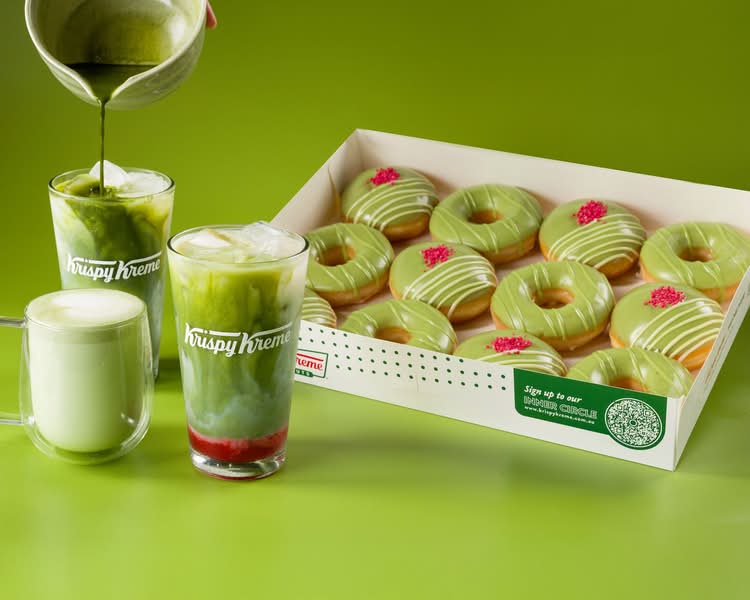
Krispy Kreme UK & Ireland has announced a strategic partnership with matcha energy brand Perfect Ted, launching a limited-edition product lineup under the campaign banner 'Grab Your Greens'. comments debug Exchange Write a comment Write a comment Share Your Thoughts Be the first to write a comment. The Newsroom Never Miss an Update! Receive personalised weekly email newsletters with industry news curated just for you. Email* Submit or create an account to access more > Krispy Kreme UK & Ireland has announced a strategic partnership with matcha energy brand Perfect Ted, launching a limited-edition product lineup under the campaign banner 'Grab Your Greens' . Available from 30 December until 6 February , the collaboration introduces a matcha-infused doughnut alongside a duo of functional lattes. The launch taps into the "New Year" wellness trend while maintaining the indulgence associated with the doughnut giant, leveraging the growing consumer appetite for Japanese green tea flavours. Product Architecture and Flavour Innovation The range features a hybrid flavour profile, blending earthy ceremonial-grade matcha with fruity and sweet notes characteristic of the Krispy Kreme menu. The Doughnut: 🍓🍵 Strawberry Matcha Doughnut: An Original Glazed® base filled with strawberry-flavoured Kreme, coated in a matcha icing, and finished with dried strawberry pieces. The Beverage Lineup: Marking a category first for the brand, Krispy Kreme is introducing two matcha lattes formulated with oat milk and Perfect Ted’s ceremonial-grade matcha. Crucially, these drinks are engineered to carry flavour notes inspired by the brand’s signature Original Glazed doughnut. 🍵 Original Glazed Matcha Latte (Hot) 🧊 Iced Matcha Latte (Cold) Strategic Context and Availability The partnership with Perfect Ted—a challenger brand known for its clean-energy positioning—allows Krispy Kreme to offer a "green" alternative during a period typically dominated by health resolutions, without pivoting entirely away from treats. Distribution: Krispy Kreme Shops: The full range is available across all UK and Ireland locations. Retail Exclusive: The Strawberry Matcha Doughnut has secured an exclusive listing at selected Tesco stores in mainland UK for a limited period, expanding the campaign's reach into the grocery channel. Krispy Kreme Partners with Perfect Ted for Limited-Edition 'Grab Your Greens' Matcha Range January 15, 2026 New Products Dunkin' Expands Halloween Lineup with Berry Battie Refresher New Products Myprotein Launches Krispy Kreme Original Glazed Whey Protein Powder New Products Krispy Kreme Launches Looney Tunes Doughnut Range for Halloween New Products Krispy Kreme Introduces Coffee-Flavoured Original Glazed Doughnut New Products Foodservice Bakery Beverage Confectionery Flavours & Colours Related news